
Indiana Seller's Disclosure: What to Answer Before You Accept an Offer
Realest, Northwest Indiana, selling a home
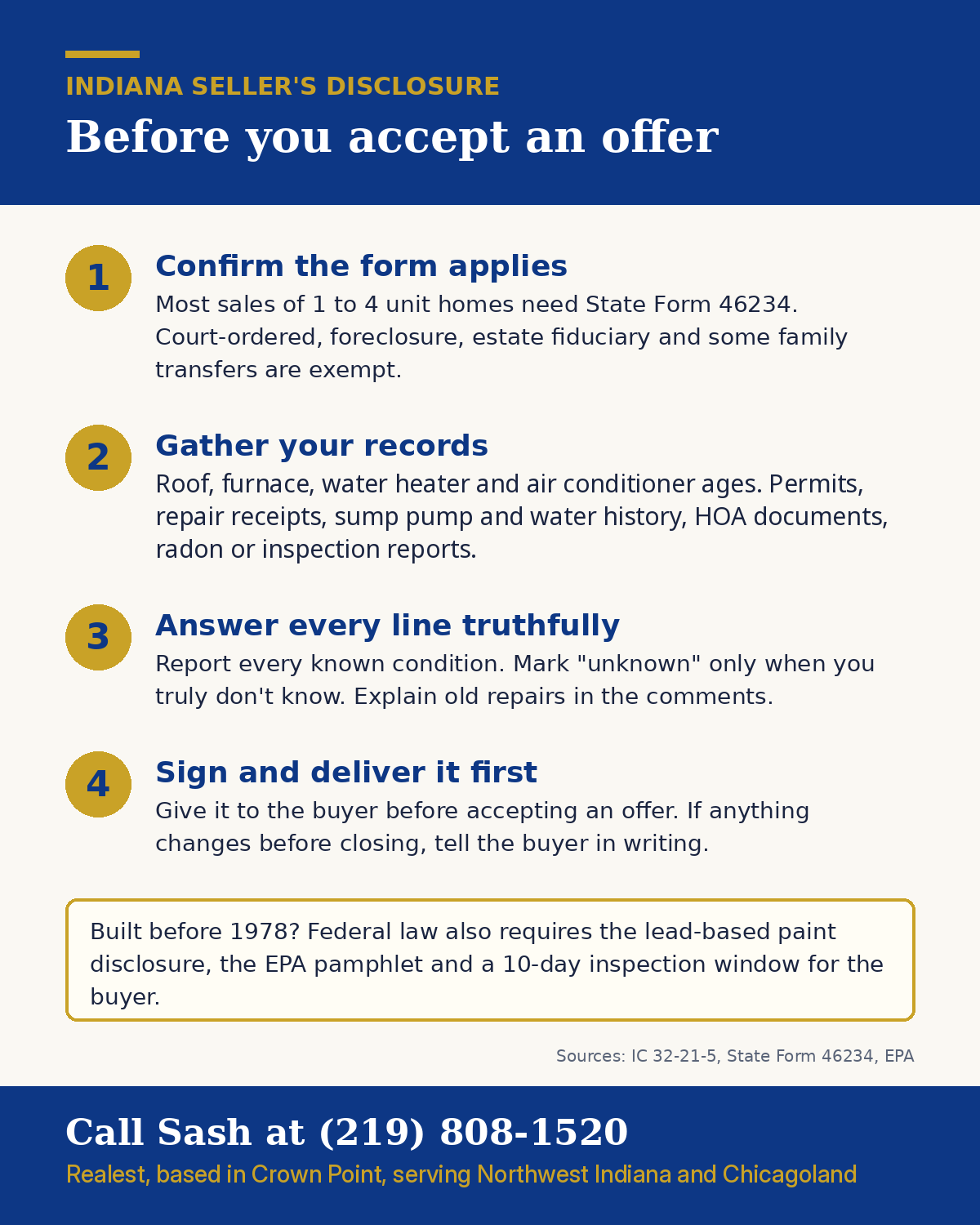
If you're selling a 1 to 4 unit home in Indiana, you generally have to fill out, sign and hand the buyer the state's Seller's Residential Real Estate Sales Disclosure (State Form 46234) before you accept an offer. You answer from what you actually know about the house, you mark "unknown" when you truly don't know, and if something changes before closing you tell the buyer in writing. It isn't a warranty and it doesn't replace the buyer's inspection, but a careless answer can sink a deal.
Prepared by Sash Joveski of Realest. Research checked November 10, 2026, against Indiana Code 32-21-5, the current state form and EPA guidance. This is general information for sellers in Lake County, Porter County and the rest of Northwest Indiana, not legal advice.

Who has to fill out the Indiana seller's disclosure?
Indiana Code 32-21-5 covers sales of residential real estate with one to four dwelling units. The current State Form 46234 lists the transfers that don't need it, including:
- court-ordered transfers, such as estate administration, foreclosure sales, bankruptcy trustee sales and divorce decrees
- sales by a lender that took the home through foreclosure or a deed in lieu
- transfers by a fiduciary handling an estate, guardianship, conservatorship or trust
- transfers between co-owners, or to a spouse, children or other direct descendants or ancestors of a seller
- transfers to or from a government entity, or because taxes went unpaid
- the first sale of a new home that has never been lived in
- transfers to a living trust.
If you're selling the house you live in, or a rental duplex you own, plan on completing the form. When an estate or trust is involved, ask the estate's attorney which rule applies before you list.
When does the buyer have to get it?
Before you accept an offer. Section 10 of the chapter says the owner must complete and sign the form and give it to the prospective buyer before an offer is accepted. It also says that, before closing, an accepted offer isn't enforceable against the buyer until both the owner and the buyer have signed the disclosure. In practice, that means the form should be finished and uploaded with your listing, not pulled together after an offer shows up.
If the buyer's lender orders an appraisal, the appraiser can ask for a copy too.
What the form actually asks
The 2026 version of State Form 46234 runs four pages. The Indiana Professional Licensing Agency's rulemaking record shows the Indiana Real Estate Commission adopted the updated form on March 11, 2026, so don't reuse a copy saved from an earlier sale. The sections are:
- Appliances, electrical, and water and sewer systems. Each item gets "not applicable/rented," "defective," "not defective" or "unknown." That includes the sump pump, water heater, smoke and carbon monoxide detectors, and whether the house is on public water and public sewer.
- Heating and cooling. Furnace, central air, boiler, heat pump, fireplace, propane tank and similar equipment.
- Roof, water heater, furnace and central air. The age of each, if you know it, plus whether the roof leaks, has damage, or has more than one layer of shingles.
- Hazardous conditions. Things like radon, mold, lead paint, asbestos insulation, methane, landfill, expansive soil, and any methamphetamine manufacturing or contamination.
- Other disclosures. The form also asks about foundation and structural problems, basement or crawl space moisture, wind, flood, termite or rodent damage, work done without a required permit, encroachments, a shared driveway, HOA covenants and dues, government notices, pending litigation, a locally designated historic district, a conservation easement, a location within one mile of an airport, and whether the property sits in a FEMA-mapped floodplain or you pay flood insurance.
The form defines a "defect" as a condition that would significantly hurt the property's value, significantly impair the health or safety of future occupants, or significantly shorten the expected life of the home if it isn't repaired, removed or replaced.
A few questions trip up Northwest Indiana sellers more than others. For the floodplain line, look your address up on the FEMA Flood Map Service Center (the form itself points there) and on Indiana DNR's Indiana Floodplain Information Portal. Our realest.net guide to flood zones in Lake and Porter counties walks through both tools. For the basement moisture line, think about every time water came in, not just whether it's dry today. For the permit line, think about finished basements, decks and additions.
What if you don't know an answer, or something changes?
The form tells sellers to answer every question truthfully, to report every known condition no matter how or when they learned about it, and to mark "unknown" only when they truly don't know. Section 12 of the law lets an owner say information is unknown or give a clearly labeled, reasonable approximation, like a roof age, based on what the owner actually knows.
Under section 11, an owner isn't liable for an error or omission that wasn't within the owner's actual knowledge, or that came from a public agency or a licensed professional's report the owner reasonably believed, as long as the owner wasn't negligent in getting and passing along that information. That protection covers real gaps in what you know. It doesn't cover leaving off a leak you already know about.
Things can change after you hand over the form. A storm damages the roof, or the sump pump fails. The form's instructions say to notify the buyer in writing right away. At or before settlement you either disclose any material change in the property's physical condition or certify that it's substantially the same as when you provided the form. There's a signature line for that on every page.
If the buyer receives the form, or an amended form, after an offer has been accepted and it discloses a defect, Indiana Code 32-21-5-13 gives the buyer two business days after receiving it to cancel the contract by delivering a written rescission to you or your agent. The buyer is not liable for canceling and is entitled to a return of any deposits. That's one more reason to deliver the form before you accept an offer.
Homes built before 1978 need a second disclosure
The Indiana form asks about lead paint, but federal law adds its own rule. According to the EPA's lead disclosure page, sellers of most housing built before 1978 must, before the buyer signs a contract:
- give the buyer the Protect Your Family From Lead in Your Home pamphlet
- disclose any known lead-based paint or lead hazards and hand over any available reports
- include a Lead Warning Statement with the contract
- give the buyer a 10-day window for a lead inspection or risk assessment, unless the parties agree in writing to change or waive it.
Sellers and their agents keep the signed disclosure for three years after the sale. If you have an old radon test, include it with your records too. The EPA's radon resources for real estate explain what buyers usually ask for.
How we help sellers prepare it
We'd rather you finish the form calmly at the kitchen table than rush it after the first showing. Before your listing goes live, pull together:
- Ages and receipts. Roof, furnace, water heater and air conditioner install dates, plus repair invoices and any warranties that transfer.
- Permits. Check with your town or county building department for work like a finished basement, a deck or an addition.
- Water history. Sump pump replacements, waterproofing work and any insurance claims.
- Reports. Past inspections, radon tests, termite treatments and septic or well paperwork, if your home has them.
- HOA documents. Covenants and the current dues amount. Indiana Code 32-21-5-8.5 caps what an association can charge for a resale statement of unpaid assessments at $50.
Fill out the form yourself, since the instructions say the seller completes it. Your agent can explain what a question means but shouldn't answer for you. When you aren't sure whether something counts as a defect, disclose it and explain it in the comments section. A buyer who reads about an old, repaired leak up front is much less likely to walk away than one whose inspector finds water stains you never mentioned. Our post on why home sales fall apart covers more of the surprises that break deals, and 15 things to do (and not do) before selling covers listing prep. When you're interviewing agents, use our list of questions to ask a listing agent. For more seller topics, see the Realest seller resources.
Indiana seller's disclosure questions
Do I have to fill out a seller's disclosure to sell my house in Indiana?
Usually, yes. Indiana Code 32-21-5 requires sellers of residential property with one to four units to complete and sign State Form 46234 and give it to the buyer before accepting an offer. Exceptions include court-ordered sales, foreclosures, estate and trust fiduciary sales, transfers between co-owners or close family, and the first sale of a never-occupied new home.
When must the seller's disclosure be given to the buyer in Indiana?
Before an offer is accepted. Before closing, an accepted offer isn't enforceable against the buyer until both the owner and the buyer have signed the disclosure form.
Is the Indiana seller's disclosure a warranty?
No. The law says the form is not a warranty by the owner or the owner's agent and is not a substitute for inspections or warranties the buyer may get. Buyers are encouraged to get their own inspections.
Can I mark "unknown" on the Indiana seller's disclosure form?
Yes, but only when you truly don't know the answer. You may also give a clearly labeled, reasonable approximation, such as a roof age, based on what you actually know. Report every known condition, however you learned about it.
What if something changes after I give the buyer the disclosure?
Tell the buyer in writing right away. At or before settlement, you must disclose any material change in the property's physical condition or certify that the condition is substantially the same as when you provided the form. If the buyer receives the form, or an amended form, after an offer has been accepted and it discloses a defect, the buyer has two business days to cancel in writing and is entitled to a return of any deposits.
Do I need a lead paint disclosure when selling an older home in Indiana?
If the home was built before 1978, federal law generally requires the lead-based paint disclosure, the EPA pamphlet, a Lead Warning Statement and a 10-day inspection opportunity for the buyer, in addition to the Indiana form. Call Sash at (219) 808-1520 with questions about your sale.
Selling in Northwest Indiana? Start with Realest
Realest is based in Crown Point and works with sellers across Northwest Indiana and Chicagoland. We'll go over the form with you before you list, help you collect the records that answer its questions, and make sure the buyer has it before any offer is accepted.
Call Sash at (219) 808-1520 · saso@realest.com · Contact Realest
Realest112 S. Main St., Suite B
Crown Point, IN 46307
Love Thy Neighbor.
General educational information, not legal advice. Disclosure rules, forms and exemptions can change, and how they apply depends on your sale. For questions about an estate, trust, divorce or specific liability, talk with an Indiana real estate attorney.
Categories
- All Blogs (104)
- buyers (7)
- commercial (2)
- Community & Lifestyle (25)
- first time buyers (12)
- Home Buying Tips (13)
- Home Selling (4)
- homebuyers (12)
- Homeownership & Maintenance (4)
- Join Realest (5)
- Listings (16)
- Local Market Insights (18)
- real estate (12)
- real estate agent (14)
- Real Estate Investing (2)
- Real Estate News & Trends (5)
- sellers (6)
- selling (3)
Recent Posts









Realest.com
Phone